
Late August is when we start hearing the same question: can we get the bathroom done before the holidays? For many projects the answer is yes, as long as you start planning now. Here is what a bathroom remodel really costs in Northern Virginia in 2026, what drives the number, and how long the whole process takes.
How much does a bathroom remodel cost in Northern Virginia?
Short answer: Most Northern Virginia bathroom projects in 2026 fall into three tiers: a cosmetic refresh at roughly $10,000 to $20,000, a full remodel of a hall or secondary bath at about $30,000 to $55,000, and a primary or luxury bath from about $60,000 to well over $100,000. Layout changes, tile, and glass drive most of the difference.
These are typical ranges for licensed, permitted work in Fairfax County and nearby, not quotes. Your number depends on the size of the room, the age of the house, and the choices you make in the showroom. Adding a brand-new bathroom downstairs is a different project, which we cover in our guide to finishing a basement in Fairfax County.
| Tier | Typical scope | Typical 2026 range |
|---|---|---|
| Cosmetic refresh | New vanity and top, toilet, faucets, lighting, mirror, and paint. Existing tub and wall tile stay. | $10,000 to $20,000 |
| Mid-range full remodel | Hall or secondary bath taken to the studs: new tub or shower and tile, vanity, toilet, fan, and lighting in the same layout. | $30,000 to $55,000 |
| Primary or luxury bath | Larger room, walk-in or curbless shower, frameless glass, double vanity with stone top, heated floor, often a new layout. | $60,000 to $120,000 and up |
What does national cost data say?
The 2025 Cost vs Value report, a long-running national survey originally published by Remodeling magazine, put the national average midrange bath remodel at $26,138 and an upscale bath remodel at $81,612. A universal design bath, built for accessibility, averaged $42,183. At resale, those projects recouped about 80, 42, and 61 percent of their cost.
Treat those as a floor, not a target. Northern Virginia labor runs above national averages, and many of the homes we work on in Vienna, McLean, and Fairfax were built in the 1960s to 1980s. Opening walls in those houses often turns up galvanized supply lines, cast iron drains, or a subfloor softened by decades of small leaks around the toilet.
What drives the cost of a bathroom remodel?
Moving plumbing and changing the layout
Keeping the toilet, sink, and shower where they are is the single biggest way to control cost. Moving a toilet means new drain routing through the floor framing, and relocating a shower may mean new venting and a new valve location. Moving walls to borrow space from a closet adds framing, drywall, and electrical work.
Tile scope and the shower itself
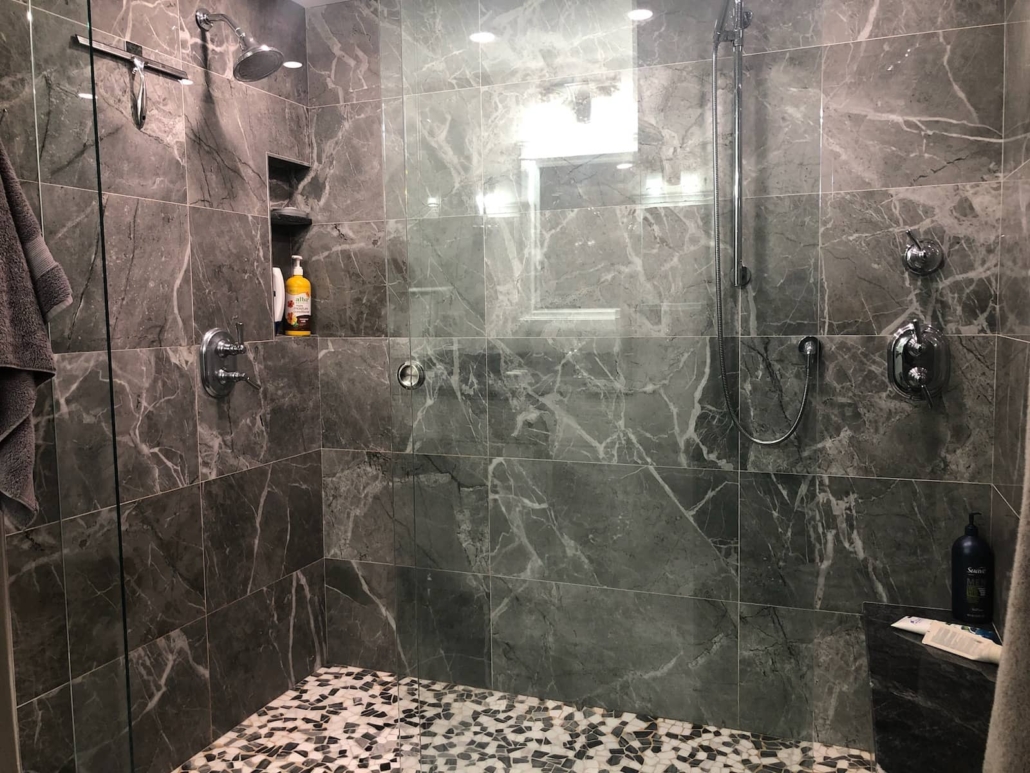
Tile is labor-heavy. A tub with a tiled surround to 6 feet costs far less than a floor-to-ceiling tiled walk-in shower with a niche, a bench, and a linear drain. Curbless showers need the shower floor recessed (or the rest of the bathroom floor raised) so water still flows to the drain, which can mean reframing part of the floor. Large-format porcelain looks clean with fewer grout lines, but it needs a flatter substrate and more careful setting.
Waterproofing
Tile and grout are not waterproof on their own. A well-built shower has a continuous waterproofing layer behind the tile, such as a bonded sheet membrane or a liquid-applied coating, carried down into a properly sloped pan. It adds cost to the shower, and it is the last place we would cut.
Glass, vanities, and counters
A frameless glass enclosure is measured after tile is finished and can run several thousand dollars on its own. Vanities range from stock boxes to semi-custom or furniture-style pieces, and a stone or quartz top with an undermount sink adds to that. A double vanity doubles the faucets, sinks, and plumbing connections.
Ventilation and electrical
Many older bathrooms have a weak fan, or one that dumps into the attic instead of venting outdoors. A properly ducted, quiet fan, GFCI-protected outlets, better lighting, and a heated floor all add electrical work, and sometimes a new circuit from the panel.
How long does a bathroom remodel take?
Plan the project in three stretches:
- Design and selections: usually 2 to 4 weeks to settle the layout and pick tile, fixtures, vanity, and lighting.
- Ordering and permits: stock items can arrive within days, while custom vanities and special-order tile or fixtures can take several weeks. Permit review runs at the same time.
- Construction: roughly 3 to 5 weeks for a typical hall bath and 5 to 8 weeks or more for a primary bath. Glass is measured after tile and is often installed one to three weeks later.
If you finish design by mid-September, a hall bath can usually be done before Thanksgiving on November 26. A primary bath with custom glass and a new layout is tighter, and we will tell you honestly if the calendar does not work.
Good to know: Order everything before demolition starts. A backordered valve or vanity can leave a bathroom half-finished for weeks, and that delay is easy to avoid.
Do you need a permit for a bathroom remodel in Fairfax County?
Usually, yes. Fairfax County lists bathroom remodels among interior renovations that need a building permit, and new or relocated plumbing fixtures, outlets, lights, and switches need trade permits. Moving or adding walls needs a building permit too. The county does not require a permit to replace a vanity or countertop, replace flooring and tile, paint, or swap fixtures like for like in the same location.
Applications go through the county’s PLUS portal, and plumbing and electrical permits follow the building permit. Our guide to the Fairfax County permit process uses a deck as the example, but the steps are the same. Homes in the Town of Vienna also need town approval.
Where should you spend, and where can you save?
- Spend on what you cannot see: waterproofing, a good pressure-balancing or thermostatic valve, a properly vented fan, and solid subfloor repairs.
- Spend on installation: tile set flat and square looks better with a mid-priced tile than expensive tile set poorly.
- Save on tile: porcelain that looks like marble or stone costs less and needs less care than the real thing.
- Save on the vanity: a quality semi-custom or ready-made vanity with a quartz top often looks just as good as full custom.
- Save on layout: keep the plumbing where it is unless the current layout truly does not work.
Should you plan for aging in place?
If you plan to stay in your home for the long run, this is the cheapest time to build it in. A curbless or low-threshold shower, wood blocking in the walls for future grab bars, a handheld shower on a slide bar, a comfort-height toilet, and a wider door add little cost during a remodel and a lot later. Our post on aging-in-place remodeling and the Virginia Livable Home Tax Credit covers the details.
How we help with bathroom remodels
We handle bathroom projects from layout and selections through Fairfax County permits, demolition, plumbing, electrical, waterproofing, tile, and final inspection, with one team responsible for the schedule. Before work starts, we walk you through the scope and allowances so you know where the money is going. Learn more on our bathroom renovation page, or see how we work with homeowners in McLean, VA and nearby towns.
Bathroom remodel cost FAQs
Is a heated bathroom floor worth it?
For many households, yes, especially in a primary bath or a basement bathroom where tile feels cold in winter. Electric radiant mats are set in the thinset under the tile and run on a programmable thermostat, often on a dedicated circuit. The cost is mostly the mat, the thermostat, and electrical work, and it is far easier to add during a remodel than later.
Is it cheaper to replace a tub with a walk-in shower?
Not always. A simple tub-to-shower conversion with a prefabricated base can cost about the same as a new tub and tile surround. A fully tiled walk-in shower with frameless glass usually costs more. If it is your only tub, think about resale, since many families with young children want at least one bathtub in the house.
How much contingency should I budget for a bathroom remodel?
Set aside 10 to 15 percent of the project cost, and closer to 20 percent in a house built before about 1980. Common surprises include rotted subfloor around the toilet, old galvanized or cast iron piping, wiring that needs updating, and walls that are out of plumb. If you do not need the cushion, it stays in your pocket.
Can I live in my house during a bathroom remodel?
Yes, as long as you have another working bathroom. Expect noise during demolition and tile cutting, and plan for workers in the house most weekdays. The work area should be sealed with dust barriers and the path to the bathroom protected. If it is your only bathroom, talk with us about scheduling and temporary options before work starts.
What is the most expensive part of a bathroom remodel?
Labor usually is, and the shower is where most of it goes. Tiling, waterproofing, and plumbing a walk-in shower take more skilled hours than anything else in the room. After that, frameless glass, moving fixtures to a new layout, and custom vanities with stone tops are the line items that push a budget up fastest.
Cost ranges are typical for Northern Virginia in 2026 and are not quotes. Permit rules reflect Fairfax County guidance as of August 2026; confirm with Fairfax County Land Development Services or your town before you start.
Want your bathroom done before the holidays, or planned right for spring? Request a free consultation or call 703-587-7762, and we will give you an honest range and a realistic schedule for your space.