
August is when Northern Virginia basements tell the truth. On a sticky afternoon, a basement with a moisture problem smells musty, sweats along the foundation walls, and drips from the cold water pipes. If you are thinking about finishing yours, this is the best time of year to see what you are really working with, before anyone hangs a sheet of drywall.
Do you need a permit to finish a basement in Fairfax County?
Short answer: Yes. Fairfax County requires a residential building permit to finish a basement, plus an electrical permit, and a plumbing permit if you add a bathroom, wet bar, or other plumbing. You apply online through the county’s PLUS system. Finished basements are on the county’s fast-track list, so a complete, accurate submission usually moves quickly.
Electrical and plumbing permits are issued after the building permit. If you have never used PLUS, our walkthrough of the Fairfax County deck permit process shows how records, uploads, and inspections work. A basement follows the same path.
Your plans need to show each room and its use, ceiling heights, the furnace, water heater, and panel, bathroom exhaust, smoke and carbon monoxide alarm locations, and any egress window and window well. The county also publishes standard finished basement details that can stand in for custom drawings if the work follows them exactly. Expect a combined framing inspection before anything is covered and a combined final once fixtures and finishes are in.
Local tip: If you live in the Town of Vienna or Clifton, the county requires town approval as part of your permit package. The City of Fairfax and the City of Falls Church run their own building departments, so the county process does not apply there.
How do you keep a finished basement dry?
Fix the water before you finish the room. Drywall, carpet pad, and wood framing all feed mold, and a basement that is damp in August will be damp behind your new walls too. The EPA recommends keeping indoor humidity below 60 percent, ideally between 30 and 50 percent, and a basic hygrometer costs about $10 to $50. Leave one downstairs for a week this month and you will know where you stand.
Start outside
Most of the basement water problems we see start at the roof edge and the grade. Clean the gutters (our heavy tree cover fills them fast), extend downspouts several feet from the foundation, and make sure the soil slopes away from the house. The residential code’s standard for new grading is a fall of at least 6 inches over the first 10 feet. Much of Fairfax County sits on clay soils, and some neighborhoods have marine clay, which holds water against foundations. If this summer’s storms gave you trouble, our post-storm roof and gutter checklist is a good place to start.
Then control moisture inside
- Sump pump: If you have one, test it and consider a battery backup. Summer thunderstorms and power outages tend to arrive together.
- Insulation and vapor control: Fairfax County’s details call for at least R-13 insulation on basement walls. Department of Energy Building America guidance warns against plastic sheeting on the inside of basement wall insulation because it traps moisture against the concrete. Rigid foam board directly on the foundation wall is a drier approach.
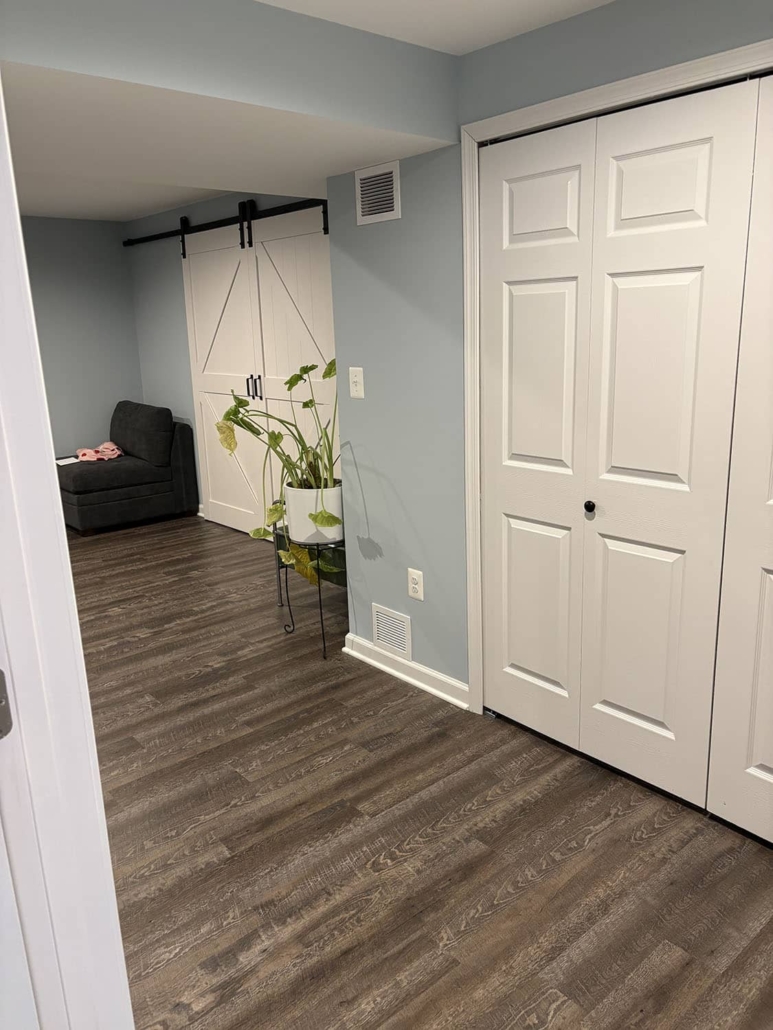
- Mold-resistant materials: Use moisture- and mold-resistant drywall, hold it slightly off the slab, and choose flooring that tolerates damp conditions, such as luxury vinyl plank.
What are the egress rules for a basement bedroom?
Every basement bedroom needs an emergency escape and rescue opening, usually a larger window with a window well, no matter when the house was built. Fairfax County’s typical details, based on the 2021 Virginia Residential Code, also require one in the basement of any house built after October 1, 2003. Older basements without a bedroom can be finished without one, though the county strongly recommends it.
- Net clear opening of at least 5.7 square feet (5.0 square feet for a grade-floor opening)
- Clear opening at least 24 inches high and at least 20 inches wide
- Bottom of the clear opening no more than 44 inches above the finished floor
- Opens from the inside without a key or tool
- Window well with at least 9 square feet of floor area and at least 36 inches in each direction
- A permanent ladder or steps in any well deeper than 44 inches, and a well that drains
One catch: a window that only meets the 24 by 20 inch minimums opens about 3.3 square feet, so the real window has to be bigger. In most 1960s to 1980s homes in Vienna, McLean, and Fairfax, the original basement windows are small and high on the wall, so a legal opening usually means cutting the foundation and digging a new well.
What else does the code require?
Ceiling height
Fairfax County’s details call for a basement ceiling at least 7 feet above the finished floor, with beams, girders, ducts, and similar obstructions allowed down to 6 feet 4 inches. In older homes the main trunk duct often hangs lower, so we plan soffits or rerouting during design, not at inspection.
Smoke and carbon monoxide alarms
You need smoke alarms in the basement and in each basement bedroom. New alarms must be hardwired with battery backup and interconnected so they all sound together. If you add a bedroom and the house has a gas appliance or an attached garage, a carbon monoxide alarm is required outside the sleeping area.
Should you test for radon before you finish?
Yes. The Fairfax County Health Department notes that the EPA rates the county Zone 1, its highest radon potential category. The EPA recommends fixing a home at 4 picocuries per liter (pCi/L) or higher, considering a fix between 2 and 4, and testing a basement before a major renovation and again after.
If you need a mitigation system, the vent pipe and fan are far easier to place before walls close in. The Virginia Department of Health recommends testing the lowest livable level and notes that radon usually peaks in the coldest months, so a winter retest is smart. Virginia requires professional radon testers and mitigators to be certified.
How much does it cost to finish a basement in Northern Virginia?
The 2025 Cost vs Value report put the national average basement remodel at $52,012. Northern Virginia labor and materials typically run above national averages. These are typical 2026 ranges, not quotes:
| Scope | What it usually includes | Typical 2026 range |
|---|---|---|
| Basic finish | Open rec room, drywall, lighting, vinyl plank flooring, no plumbing | $35,000 to $60,000 |
| Mid-range finish | Rec room, bedroom with a new egress window, full bathroom | $60,000 to $110,000 |
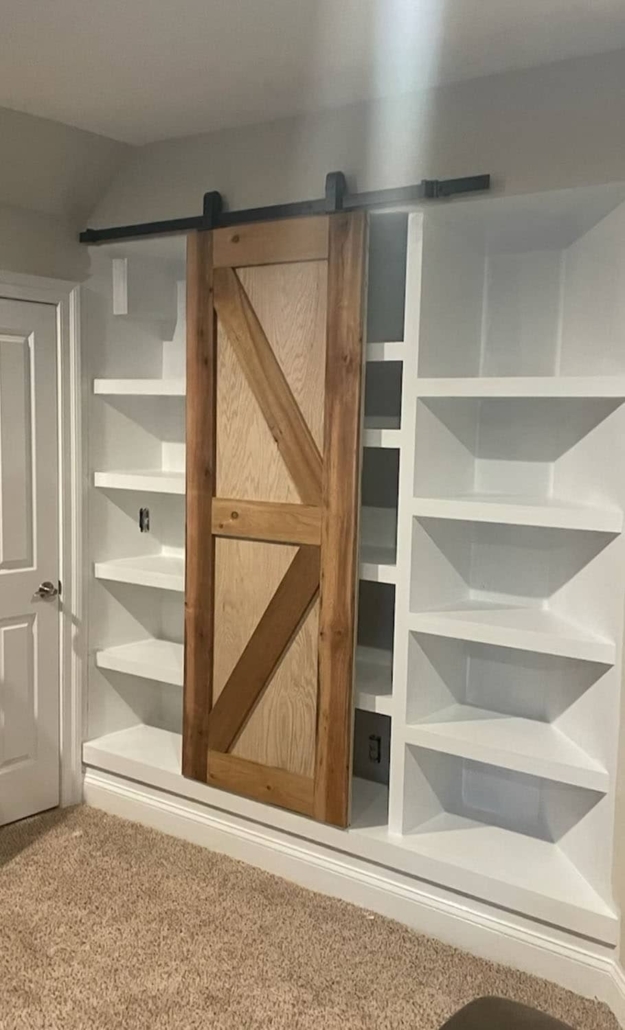
| High-end or suite | Wet bar or kitchenette, built-ins, premium finishes, in-law layout | $110,000 to $175,000 and up |
The biggest swing factors are square footage, plumbing (especially a sewage ejector pump), cutting in an egress window (often $4,000 to $10,000 with excavation, the well, and drainage), moisture repairs, rerouting low ducts, and finishes. For timing, plan on a few weeks for design, county review that can take only days for a complete fast-track submission, and roughly 6 to 12 weeks of construction.
Can you add a bathroom to a basement?
Usually, yes. If your basement has a rough-in (capped drain lines stubbed up through the slab), a bathroom is much simpler. If not, or if the main sewer line leaves the house above the basement floor, you will need a sewage ejector pump in a sealed basin, and the slab gets cut and trenched. Budget roughly $20,000 to $45,000 for a basement bathroom in Northern Virginia, depending on rough-in, size, and finishes.
The fan must vent outdoors, a shower needs at least 900 square inches of floor area and 30 inches in every direction, and shower glass must be safety glazing. Planning for a parent or your own later years? A curbless shower, grab bar blocking, and a wider door cost far less now than later. Our guide to aging-in-place remodeling in Northern Virginia covers those features and the Virginia Livable Home Tax Credit, and our bathroom renovation page shows finish ideas.
Good to know: A full apartment with its own kitchen for a relative counts in Fairfax County as an accessory living unit, allowed with single-family detached homes. It needs a separate zoning permit with limits on size and occupancy, so ask about it before you design the space.
How we help with basement finishing
When we look at a basement, we start with the unglamorous questions: where the water goes, how the ducts and beams sit, and whether a bedroom can get a legal egress window. From there we handle design, Fairfax County permits and inspections, and the build. See our basement renovation page for the work we take on. We serve the whole county, including the Fairfax, VA area, Vienna, McLean, and Oakton.
Finishing a basement FAQs
Can I finish my own basement in Fairfax County?
Yes, homeowners can apply for permits on their own homes. If no licensed contractor is listed, Fairfax County asks for a license exemption affidavit with the application. You still need the same building, electrical, and plumbing permits, and the work has to pass the same framing and final inspections a contractor’s job would.
Does finishing a basement add value to a home?
It usually adds both living space and resale appeal. The 2025 Cost vs Value report estimated that a basement remodel recoups about 71 percent of its cost at resale nationally. A permitted basement with a legal bedroom and a full bath tends to appeal most to buyers, and unpermitted work can cause problems during a sale.
Can I call a basement room a bedroom without an egress window?
Not under the code. A sleeping room needs a compliant emergency escape and rescue opening. A windowless or small-window room can still be a home office, gym, media room, or den, and many homeowners finish it that way first and add an egress window later if they need a bedroom.
What is the best flooring for a basement in Northern Virginia?
Luxury vinyl plank and porcelain tile handle humidity and minor water best. Carpet tiles work for a cozy space because damaged squares can be replaced. Solid hardwood is a poor fit below grade because it swells and cups with moisture, and the slab should be checked for moisture before any flooring goes down.
Do I need a dehumidifier in a finished basement?
Most Northern Virginia basements benefit from one in summer, even after finishing. Aim to keep humidity between 30 and 50 percent, as the EPA recommends. A unit with a continuous drain to a sump or condensate pump is easier to live with than one with a bucket you have to empty.
This article reflects Fairfax County guidance and the 2021 Virginia Residential Code as of August 2026. Confirm details with Fairfax County Land Development Services. Cost ranges are typical, not quotes.
Thinking about finishing your basement this fall? Request a free consultation or call us at 703-587-7762, and we will walk through moisture, egress, and layout with you before you commit to a plan.