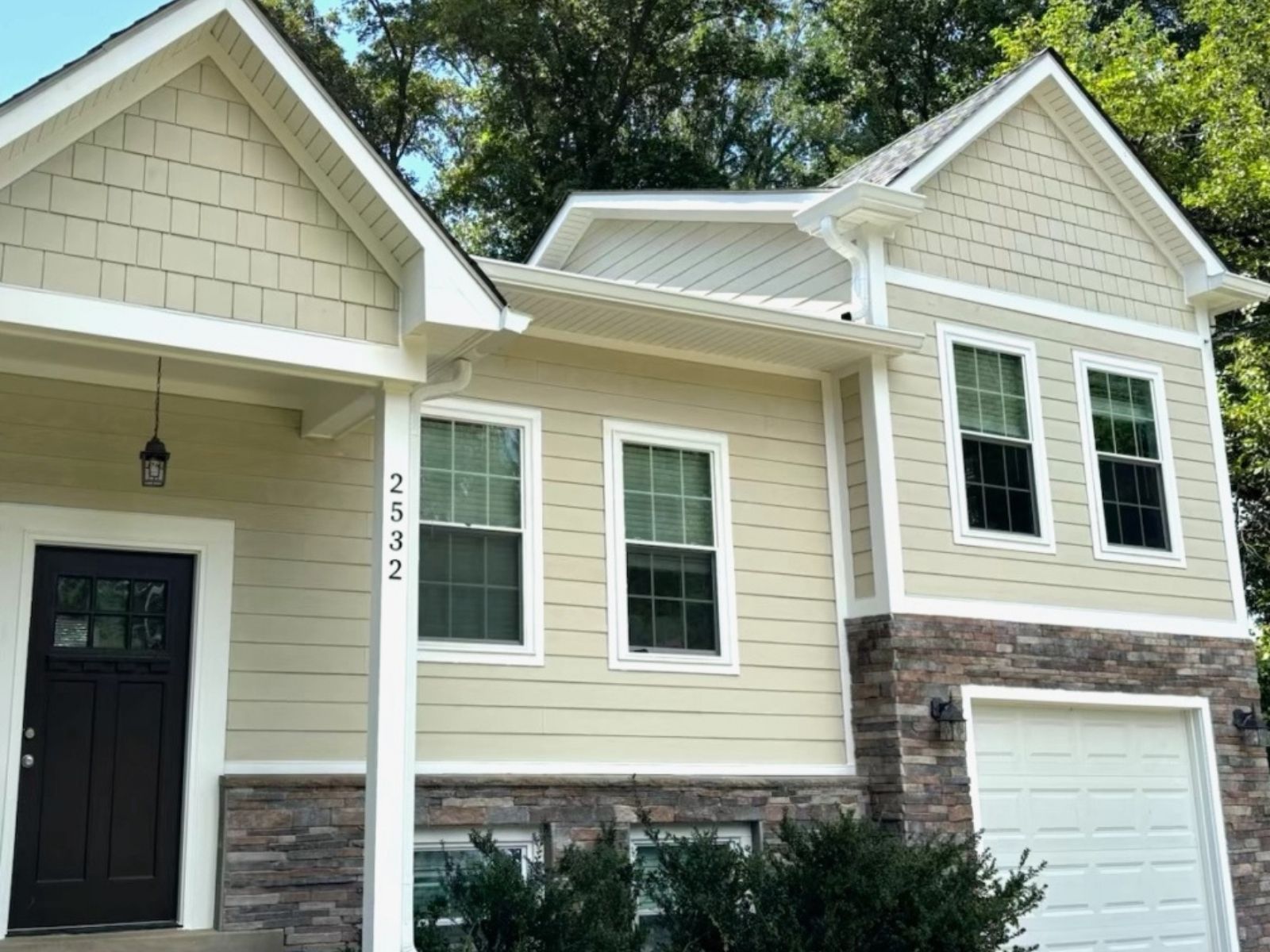
Fall is one of the best times of year to replace siding in Northern Virginia. Summer’s heat and thunderstorms are behind us, temperatures are comfortable for caulking and painting, and the work wraps up before freezing weather sets in. For most homeowners we talk with, the decision comes down to two materials: fiber cement or vinyl.
Is fiber cement or vinyl siding better for a Northern Virginia home?
Short answer: Both perform well here when they’re installed correctly over a proper moisture barrier. Fiber cement costs more but is noncombustible, handles impact better, and looks the most like painted wood. Vinyl costs less, never needs paint, and cleans up with a garden hose. Your budget, the look you want and your HOA usually decide it.
Neither material rots, and both come in a wide range of colors and profiles. Here’s how they compare on the homes we work on.
| Factor | Fiber cement | Vinyl |
|---|---|---|
| Typical installed cost (2026, Northern Virginia) | About $14 to $22 per sq ft of wall | About $9 to $15 per sq ft of wall |
| Painting | Factory finish or site paint; repaint eventually | Color runs through the panel; no painting |
| Fire | Noncombustible (ASTM E136) | Softens and warps with high heat |
| Impact and hail | Very good; corners can chip | Fair; more likely to crack in cold weather |
| Weight and install time | Heavy; more labor | Light; faster to install |
| Look | Crisp, painted-wood appearance | Many profiles; visible laps and seams |
How each holds up to Northern Virginia weather
Humidity and freeze-thaw
Our humid summers and heavy tree cover put green mildew on the shaded sides of a lot of houses, whatever the siding. Neither material rots, but both need an occasional cleaning, and the real moisture risk is behind the siding.
Vinyl expands and contracts noticeably with temperature, so it has to hang loose on its nails. Installed too tight, it buckles in summer and can pull loose in winter. It also stiffens in the cold, so a stone thrown by a mower is more likely to crack a panel in January than in July. Fiber cement moves far less, and James Hardie makes an HZ5 product line engineered for climates like ours with freezing temperatures, snow and ice.
Wind, hail and storms
Strong gusts can pop vinyl panels loose and peel them off a wall, and hail can crack or puncture them. Fiber cement is heavier and much more impact resistant, though corners and edges can chip. After a summer storm, siding deserves a look along with the roof, and our guide to checking your roof after a summer storm covers what to look for.
Heat, fire and reflected sunlight
James Hardie’s fiber cement is verified noncombustible under ASTM E136. Vinyl doesn’t ignite easily (the industry puts its ignition temperature at roughly 600°F to 790°F), but it softens and warps at far lower temperatures. A grill parked too close to the wall is a common culprit. So is sunlight concentrated by a neighbor’s low-E windows, which the Polymeric Exterior Products Association says can distort or melt vinyl and is typically not covered by siding warranties.
What does fiber cement or vinyl siding cost in 2026?
Siding is priced by the square foot of wall covered, plus trim. For 2026, typical installed prices on Northern Virginia homes run roughly $9 to $15 per square foot for standard vinyl and $14 to $22 for fiber cement, including tear-off, house wrap and standard trim. A two-story colonial in Vienna or Fairfax often has around 2,000 square feet of wall, which puts many projects in these ranges:
- Vinyl: about $18,000 to $30,000
- Fiber cement: about $28,000 to $44,000
For a national benchmark, the 2025 Cost vs Value report put an upscale fiber cement re-siding job at $21,485 and a mid-range vinyl job at $17,950, both for 1,250 square feet. Prices in our area usually run above national averages. The biggest variables are wall area and complexity, rot found once the old siding comes off, how much trim gets wrapped in PVC or fiber cement, factory finish versus site painting, and lead-safe removal on older homes.
What about insulated vinyl?
Insulated vinyl has a rigid foam backing shaped to the panel. Products made to the ASTM D7793 standard carry a tested R-value of at least R-2.0, printed on the package. It sits flatter on the wall and reduces heat loss through the studs. It costs more than standard vinyl and makes the most sense on older homes with little wall insulation.
Maintenance: painting, factory finishes and cleaning
Vinyl’s color runs through the panel, so there’s nothing to paint. Plan on washing it every year or two with a garden hose, a soft brush and a mild cleaner, and skip high-pressure washing, which can drive water behind the laps. Vinyl manufacturers commonly offer long limited warranties, often marketed as lifetime, so read the terms on proration and transfer.
Fiber cement comes either primed for painting on site or with a factory finish. James Hardie backs its ColorPlus finishes with a 15-year limited finish warranty, and its siding carries a transferable 30-year non-prorated limited substrate warranty. Either way, fiber cement will need repainting eventually, and caulked joints should be checked every few years.
Local tip: On wooded lots in McLean and Great Falls, the north side of the house often stays damp and shaded all summer. Trimming back branches that touch the siding and keeping mulch and soil a few inches below the bottom course cuts down on mildew with either material.

What’s behind the siding matters most
Most siding problems we see aren’t the siding’s fault. They come from water getting behind it at windows, doors, decks and roof lines. The building code requires a water-resistive barrier behind exterior siding, and good installation goes further:
- House wrap lapped like shingles, so water always runs over the layer below
- Flashing tape and sill pans at windows and doors
- Kick-out flashing where a roof edge meets a wall
- Proper flashing where a deck ledger attaches to the house
- Manufacturer-specified clearances from the roof, ground, decks and walkways
If your roof is also near the end of its life, doing roofing and siding together lets the crews flash every roof-to-wall intersection once, the right way. Planning a deck too? The ledger is easiest to flash while the siding is off, and our post on the best time to build a deck in Northern Virginia can help you line up the schedule.
Many 1960s to 1980s homes here still have wood trim that rots at the bottoms of corner boards and sills. Cellular PVC trim won’t rot and doesn’t need paint, though it moves with temperature and must be fastened correctly. If your windows are near the end of their life, replace them with the siding so they can be flashed into the new wall. Our window and door replacement team can coordinate both.
Permits, HOA approval and lead-safe rules
Do you need a permit to replace siding?
Usually not for a straight swap. The Virginia Uniform Statewide Building Code exempts siding replacement on one- and two-family homes and townhouses from permits where the nominal design wind speed is 100 mph or less, which includes Fairfax County. The county’s “Does my project require a permit?” page lists re-siding with similar material as permit-free.
The work still has to meet code. Switching to a different material, or replacing damaged sheathing or framing, is worth confirming with Land Development Services first, and a building official can require permits for siding in a locally designated historic district.
HOA approval and color changes
Many Northern Virginia HOAs have architectural review, and a change in siding material, profile or color almost always needs approval. Submit the manufacturer’s color name with a sample or brochure, build a few weeks of review into your schedule, and get written approval before ordering materials.

Lead-safe work on pre-1978 homes
Much of the housing in Vienna, McLean and Fairfax was built before 1978, the cutoff for the EPA’s Renovation, Repair and Painting rule. On those homes, a contractor disturbing more than 20 square feet of painted exterior surface, such as old wood siding or trim, must be an EPA-certified firm using certified renovators and lead-safe work practices, and must give you the Renovate Right pamphlet before work starts. The EPA’s RRP page for homeowners explains what to expect.
How we help with siding
We install vinyl and fiber cement from manufacturers like CertainTeed, ProVia and James Hardie, along with the house wrap, flashing and trim behind them, and our work carries a 10-year transferable labor warranty on top of the manufacturer’s coverage. We’ll measure your house, price both options side by side, and handle lead-safe requirements on older homes. See our siding and trim services or the work we do in Vienna, where we’re based.
If you’re also weighing more space, our post on adding on versus moving in Northern Virginia is a good place to start, and planning new siding at the same time keeps the old and new parts of the house matched.
Fiber cement and vinyl siding FAQs
Which siding has a better return on investment, fiber cement or vinyl?
In the 2025 Cost vs Value report, fiber cement siding replacement recouped about 114% of its cost at resale nationally, compared with about 97% for vinyl. Those are national estimates, not guarantees, and results in Northern Virginia depend on your neighborhood and the condition of the house.
Can new siding go over old siding?
It sometimes can, but we rarely recommend it. Removing the old siding lets us repair rotted sheathing, install a proper water-resistive barrier, and flash windows and doors correctly. Covering old siding hides those problems. On pre-1978 homes, removing painted wood siding falls under EPA lead-safe rules, so a fair price should include that work.
How long does a siding replacement take?
Most of our siding projects take several days to about a week once materials arrive. Larger homes, fiber cement with a lot of custom trim, or rot repairs found during tear-off can stretch that. HOA review and material lead times often add a few weeks before work starts, so planning in late summer helps you finish before winter.
Is there a tax credit for insulated siding in 2026?
Not at the federal level. The IRS says the Energy Efficient Home Improvement Credit is not allowed for property placed in service after December 31, 2025, so siding installed in 2026 doesn’t qualify. Insulated vinyl can still make sense for comfort and energy savings, but budget for it without counting on a federal credit.
Cost ranges are typical 2026 planning figures for Northern Virginia, not quotes. Permit, HOA and manufacturer warranty terms change, so confirm the current requirements for your property and product before work begins.
If you’re weighing fiber cement and vinyl for your home, we’d be glad to walk the house with you and price both. Request a free consultation or call 703-587-7762 to get on our fall schedule.