Late July is when most of us are living on the patio, or wishing we had a better one. If yours is cracked, sinking, or simply too small, start planning now, because late summer and fall offer one of the best building windows of the year in Northern Virginia.
Which patio material is best for a Northern Virginia yard: pavers, concrete, or flagstone?
Short answer: There is no single winner. Concrete pavers handle our freeze-thaw winters and clay soils best and are the easiest to repair. Poured concrete costs the least up front but will crack eventually. Natural flagstone, such as Pennsylvania bluestone, looks the most upscale and costs the most. For all three, the base and drainage matter more than the surface.
What is the difference between pavers, poured concrete, and flagstone?
Concrete pavers
Pavers are individual units of dense, factory-cast concrete, laid on a thin sand bed over compacted gravel and held by an edge restraint, usually with polymeric sand in the joints. Because the surface is many small pieces, it flexes as the ground moves instead of cracking. Quality pavers meet ASTM C936, which includes freeze-thaw and de-icing salt testing.
Poured concrete
A poured patio is one continuous slab, typically about 4 inches thick, over a compacted stone base. Finishes run from a simple broom finish to stamped and colored concrete that imitates stone. It is the fastest, least expensive way to get a large flat surface. The trade-off: concrete shrinks as it cures and moves with the soil, so it will crack at some point. Experienced concrete contractors in Fairfax plan for that with control joints and a solid base.
Natural flagstone
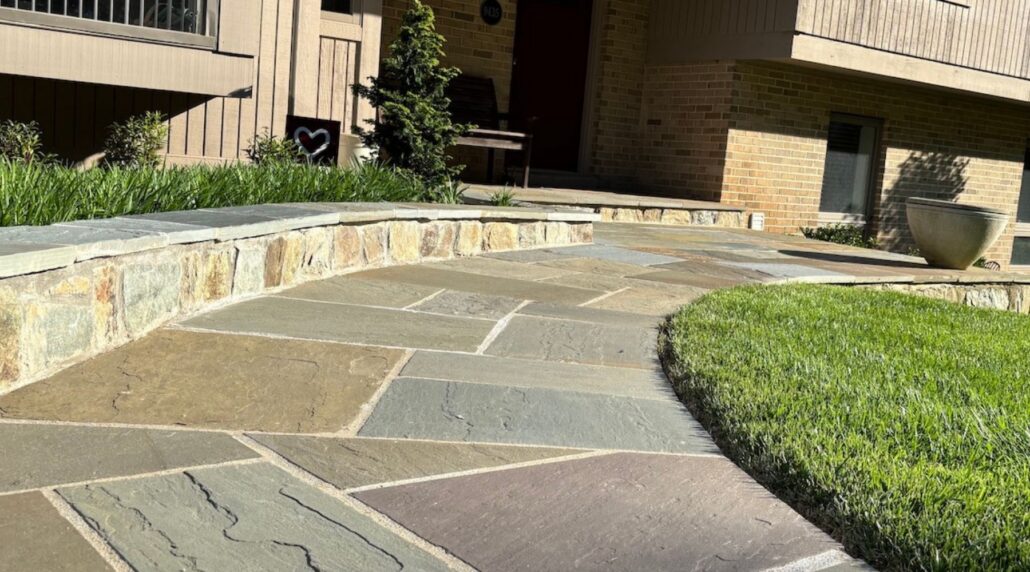
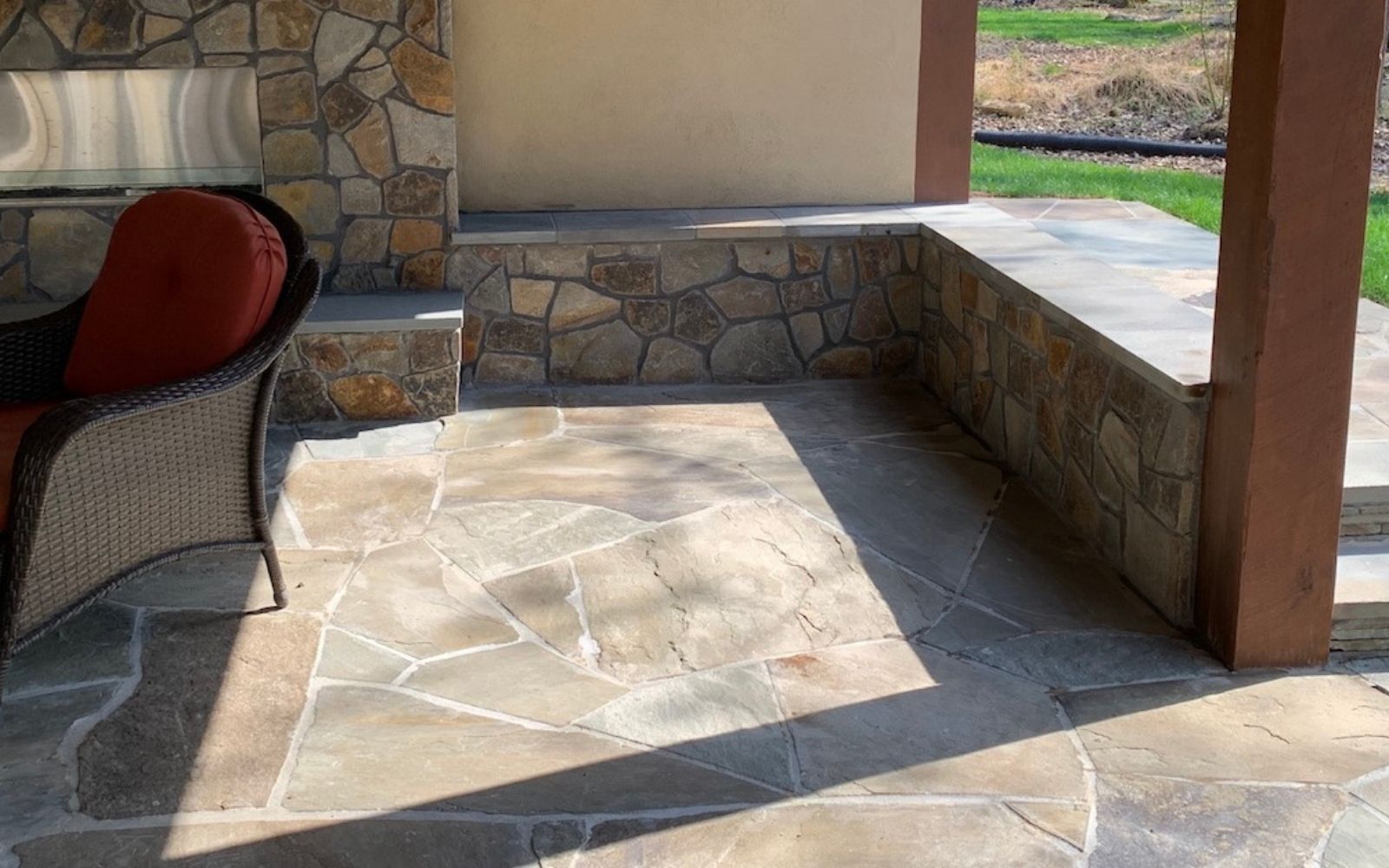
Flagstone is natural stone split into flat pieces. Around here the favorite is Pennsylvania bluestone, a dense sandstone quarried in Pennsylvania and New York. It comes in cut rectangles or irregular pieces, with a natural cleft (gently wavy) surface or a thermal finish that is torched flat and slip resistant. “Full range” bluestone mixes browns, rusts, and lilacs in with the classic blue gray. It goes down one of two ways:
- Dry-laid: stones set on sand or stone dust over a compacted gravel base, much like pavers. It stays flexible, and single stones can be lifted and reset.
- Mortar-set (wet-laid): stones bedded in mortar on a poured concrete slab. It gives a crisp, formal look, but it costs the most and is only as good as the slab underneath.

How do clay soils and freeze-thaw winters affect a patio?
Our winters are not brutal, but temperatures swing above and below freezing again and again. Each time water trapped in the base or under a slab freezes, it expands and pushes up. Add the heavy clay found across much of the region, which holds water and drains slowly, and you get the heaving and cracking we see on so many older patios. When ice does come, our guide to de-icers and winter care for patios and decks covers which products are safe on each material.
Parts of southeastern Fairfax County, mostly east of I-95 and I-395, also sit on marine clay, which shrinks when dry and swells when wet. The county’s homeowner’s guide to marine clay notes that slabs are especially vulnerable there.
- Pavers and dry-laid flagstone flex. Movement shows up as an uneven piece you can reset.
- Poured concrete is rigid, so movement shows up as cracks or a heaved section to cut out.
- Mortar-set flagstone cracks along with its slab, and water in cracked mortar speeds up freeze-thaw damage.
Base and slope are what you are really paying for
For any material, the cure is the same: dig out soft soil, lay geotextile fabric over clay so it does not mix into the base, and compact an aggregate base in layers. Unilock, for example, calls for 4 to 6 inches of compacted base for walkways and patios, placed in 3 to 4 inch lifts, and deeper digging in clay.
The patio also has to shed water away from your foundation. Manufacturers typically recommend a 1 to 2 percent slope (roughly 1/8 to 1/4 inch per foot), and the residential code calls for hard surfaces within 10 feet of the foundation to slope at least 2 percent away. Flat clay lots may also need a drain, a swale, or longer downspout extensions.
Local tip: If your patio will sit under a deck, the same water problems show up in a tighter space. Our guide to under-deck drainage in Northern Virginia covers ceiling systems and grading that pair well with a patio below.
What does a new patio cost in Northern Virginia in 2026?
National cost guides show lower numbers than you will see here, because labor, disposal, and delivery cost more in the Washington region. These are typical 2026 installed ranges for a straightforward, accessible backyard, meant for planning rather than as quotes.
| Patio type | Typical installed cost | About 300 sq ft (15 by 20 ft) | How repairs go |
|---|---|---|---|
| Poured concrete, broom finish | $12 to $20 per sq ft | $3,600 to $6,000 | Seal small cracks; cut out and re-pour damaged sections |
| Stamped or colored concrete | $18 to $30 per sq ft | $5,400 to $9,000 | Same as plain, and patches are hard to match |
| Concrete pavers | $25 to $40 per sq ft | $7,500 to $12,000 | Lift, re-level, and reset pavers |
| Dry-laid flagstone | $28 to $45 per sq ft | $8,400 to $13,500 | Reset individual stones |
| Mortar-set flagstone on a slab | $40 to $60 per sq ft | $12,000 to $18,000 | Repoint joints; slab problems are costly |
The biggest price drivers are access (no machine access means wheelbarrows and more labor), demolition and haul-off of an old slab or excess soil, grading and drainage on sloped or soggy lots, walls and steps, and material and pattern (premium pavers, thermal bluestone, curves, and borders all add cost). On walls, note that Fairfax County requires a permit for a retaining wall that holds 3 feet or more of soil, supports a patio or driveway, or is tiered.
How much upkeep does each patio need, and which looks best?
Pavers: sweep, rinse, and refill joint sand where it washes out. Polymeric sand needs a dry window to set; one major brand calls for 32°F or above and up to 24 hours without rain, depending on the base. Sealing is optional, and the paver industry does not consider it essential.
Poured concrete: control joints, the grooves cut or tooled into the slab, give concrete a planned place to crack. A common rule is to space them no more than 2 to 3 times the slab thickness, in feet (8 to 12 feet apart for a 4-inch slab), and cut them about a quarter of the slab’s depth. Exterior concrete should also be air-entrained for freeze-thaw resistance. After that, seal hairline cracks, consider a penetrating sealer, and keep de-icing salt off new concrete its first winter.
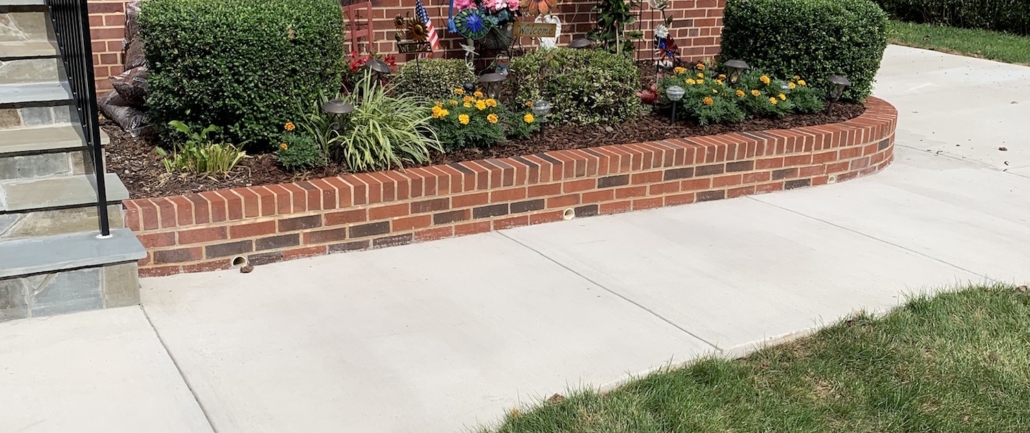
Flagstone: dry-laid stone needs the same joint care as pavers. Mortar-set stone needs joints checked and repointed as they crack, and many owners seal bluestone every few years to limit staining.
Looks and resale: flagstone reads as the most upscale and suits brick colonials and wooded lots in McLean and Great Falls. Pavers come in many colors and textures, including stone look-alikes, and well-done stamped concrete can look sharp. For resale, condition matters more than material: a level, crack-free patio helps a listing, and a heaved one becomes a buyer’s bargaining chip.
Do you need a permit for a patio in Fairfax County?
Usually not a building permit. Fairfax County lists on-grade paver and concrete patios among projects that do not need one, unlike a raised deck (see our Fairfax County deck permit guide). But no building permit does not mean no approvals:
- Town of Vienna. Inside town limits, patios require a zoning permit from the town.
- Zoning setbacks. The county recommends checking with Zoning about setbacks, even for exempt work.
- Resource Protection Areas. If your lot backs to a stream, part of it may be in a Chesapeake Bay Resource Protection Area, where Fairfax treats patios as impervious surfaces that can need county review or a formal exception.
- Land disturbance. Disturbing 2,500 square feet or more, counting work and access areas, requires a grading plan and land disturbance permit.
- Your HOA. Most associations want to review location, material, and color first.
- Virginia 811. State law requires contacting 811 at least three working days before digging, and it is free.
Is late summer or fall a good time to build a patio?
Yes, and it is one of our favorite windows. Late August through October is easier on fresh concrete than July heat, the ground is usually drier than in spring, and a new patio gets time to settle before the first freeze. Concrete and polymeric sand both need dry, above-freezing weather, so we aim to finish hardscape work before winter.
Good to know: If concrete is poured in the fall, plan on a penetrating sealer before winter and no de-icing salt during its first year. Use sand for traction instead.
Still deciding between a patio and a raised outdoor space? Our comparisons of screened porches, sunrooms, and open decks and of composite, wood, and PVC decking can help.
How we help
Our team builds paver, concrete, and natural stone patios across Vienna, McLean, Fairfax, Great Falls, and Oakton, and every project starts by looking at the soil, the slope, and where the water goes. We handle excavation, base, drainage, and installation, and we help with HOA submissions so paperwork does not hold up the schedule.
See materials and options on our patios and stonework page. We work throughout Vienna, VA and nearby towns.
Patio material FAQs
How long does a paver patio last?
A well-built paver patio can last for decades. The pavers themselves rarely wear out. Problems usually come from a thin base, poor drainage, or washed-out joint sand. Because individual pavers can be lifted and reset, most issues can be repaired in place without tearing out the whole patio.
Is stamped concrete a good choice in Northern Virginia?
It can be, with the right expectations. Stamped concrete gives a stone or brick look for less than pavers or flagstone, but it cracks like any slab, and patches are hard to match. It also needs resealing every few years to protect the color and surface from water and de-icing salt.
Can you put pavers or flagstone over an existing concrete patio?
Sometimes. If the slab is sound, level, and drains away from the house, it can serve as a base for mortar-set stone or thin pavers. If it is cracked, heaved, or slopes toward the house, covering it only hides the problem for a while. We also check door threshold heights before recommending an overlay.
Are permeable pavers worth it?
Permeable pavers let rain soak through wider joints into a deep stone base, which can help on lots with runoff problems. They cost more because the base is deeper and built to stricter specs, and heavy clay may need an underdrain to carry water away. They are worth considering where drainage or impervious area is a concern.
Costs are typical 2026 ranges for planning, not quotes. Permit, zoning, and HOA rules vary by property, so confirm requirements with Fairfax County, your town, and your association before you build.
Planning a new patio, or replacing one that has heaved and cracked? Request a free consultation or call 703-587-7762, and we will look at your soil, slope, and drainage and talk through which material fits your yard and budget.